Author Archives: thorehusfeldt

Panmnemonicon

“Computer scientist, public debater.” Next stop: “International man of mystery.”

As the photographic evidence to the right can attest, I am now a “public debater.” Well, I guess the recent passings of Christopher Hitchens and Steve Jobs have left an intellectual vacuum in the public space that is eager to be filled by somebody who combines the modesty of the one with the intellectual honesty of the other. Somebody like me.

In fact, the epithet comes from a poster for a panel debate about the blessings of the Internet arranged by the Social Sciences at Lund University, Debatt i Lund. I was really happy to be invited and had a good time; I hope this sets a precedent for more involvement of academics from the technical and natural sciences. The nerds.

In preparing for the debate, I spent some time reading or re-reading a few general-audience books about various societal aspects of the Internet, including the relatively recent The Filter Bubble and Program or be Programmed. I remain impressed by Blown to Bits, which combines a minimal amount of alarmism with an honest ambition to actually explain what is going on. It’s written by nerds, so the facts are correct. For nonspecialists, this should be the one book to read.

I also refreshed some sociological aspects. As a newly minted public intellectual I feel it behooves me to drop Foucault into conversation at regular intervals, instead of my usual spiel of an intertextual hodgepodge of Star Trek, Monty Python, and fantasy novels.

Foucault is topical because of his treatise on discipline and punishment that includes a famous description of modern society in terms of prison architecture. This design goes back to the English utilitarianist Jeremy Bentham and is called the Panopticon: the prison is circular, with a centrally placed warden able to inspect all the cells on the perimeter. This is clever not so much for the actual surveillance, but for the inmate’s constant knowledge of being potentially watched. It’s a correction facilty by design.

Foucault uses this design to make some point about modern society, with several institutions (such as schools) playing the role of the warden. This is good stuff; I had a chance to reacquaint myself with these notions recently when reading the spectacular The Judging Eye by R. Scott Bakker. (Fantasy novel reference duly dropped.)

As with all dystopias, Foucault’s Panopticon is of course an old hat by now. We’re living it, just as the London of Orwell’s 1984 is in fact the London of today. Some media theorists have taken Foucault’s Panopticon to the next level and speak of a Panspectron to describe our society: instead of us surrounding a centrally placed warden who sees us, we’re now surrounded by countless sensors that measure us in many other ways than just optically. I think Branden Hookway is the one to read about this. (Which I haven’t done.)

While I think this is a valid concept, I’m not too fond of the name. Panspectron. It’s basically the same word as Panopticon, with Latin replacing the Greek.

Thus, wearing my “public intellectual” mantle (which is, in fact, just a well-poured glass of Scotch) I will release a new word into memetic space that I find superior to Panspectron. Here it comes:

Panmnemonicon n. 1. A device or set of devices that records and stores everything. 2. A society operating under the influence of such a device.

Panmnemonicon translates to something like “all-remembering”, which I think is the point of our brave new world. After all, nobody actually watches you or me; mostly because nobody cares about you or me. Instead, everything is stored with the possibility of later being retrieved and mined, should you or I suddenly become interesting. That’s the worrying point, and the one that has potential impact on behaviour.

So there it is. A new word minted. Remember it, as it surely will remember you.

At the time of writing, Panmnemonicon has a total of 0 hits on Google. Panspectron does have some hits, but not enough for me to Google Trend it. We’ll see how it goes. It’s so on, Panspectron.

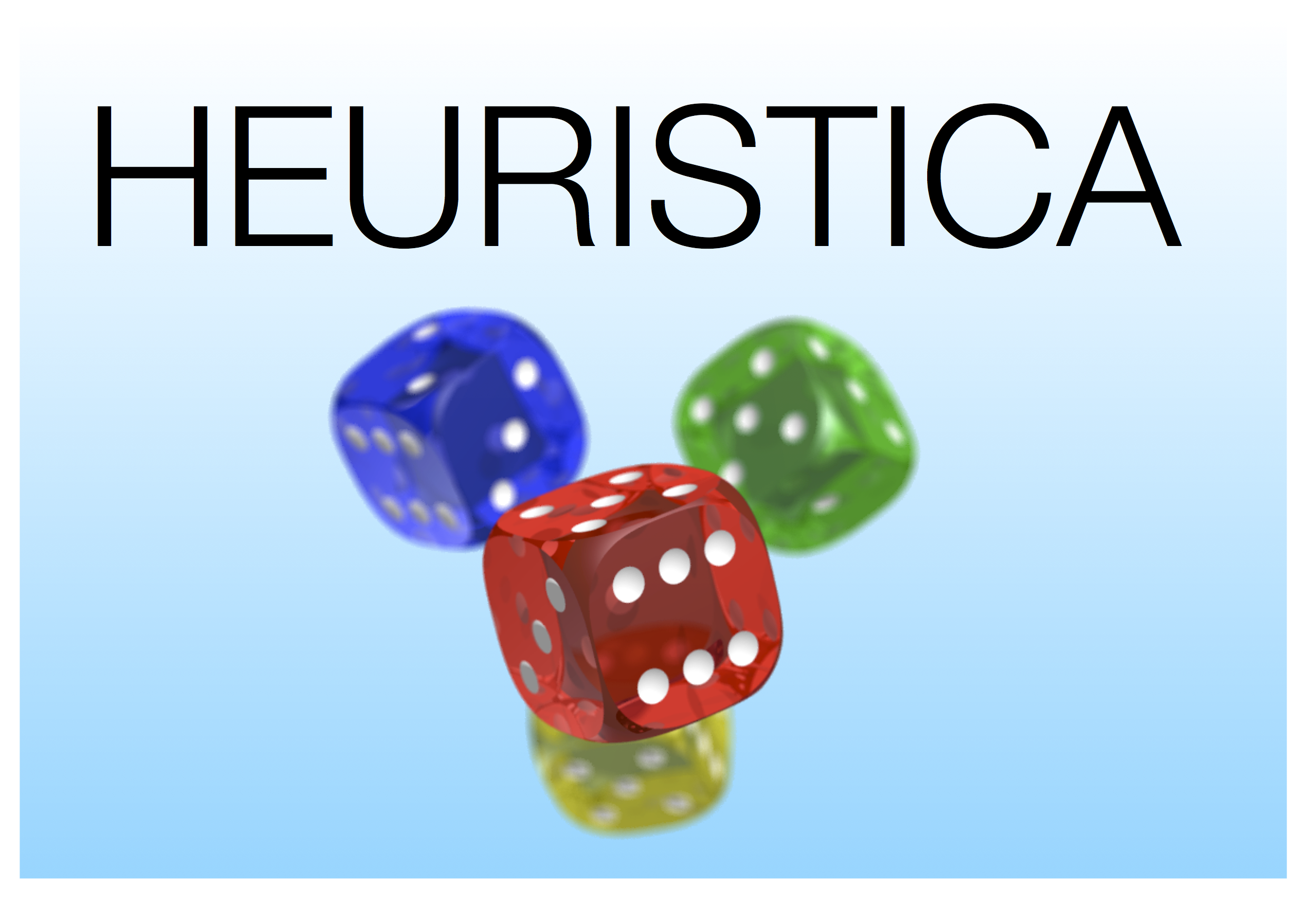
Views of Impagliazzo’s Five Worlds

I gave a popular science talk this morning about which computational world we live in. The main conceit was to couple the question about the existence of efficient algorithms for NP-hard problems to utopias in science fiction and the technological singularity. I think this worked out pretty well.

The talk was recorded by Swedish TV and will be broadcast somewhen during the Spring of 2012 on their education and facts channel Kunskapskanalen. Because of the potentially high impact I decided to apply a bit more spit and polish to the visual side of the talk. In particular, I made 5 posters to represent Impagliazzo’s five worlds of computation. These worlds provide a metaphor that I find more intellectually stimulating than the relatively stuffy formulation, “Is the complexity class P equal to the complexity class NP?”.

I think some of them came out well, even typographically. (Five points for guessing which typeface was used for Heuristica.) I hereby release them under the CC BY-SA 3.0 license; maybe somebody else can use them in a similar talk. The talk was in Swedish (or at least in whatever language I use to approximate Swedish); if an anglophone wants Kryptomanien changed to Cryptomania, or wants the PDFs, I’m happy to oblige.

Next up: mugs, mouse mats, lingerie, and a perfume series of five fragrances.

References

Five worlds of computation are from Russell Impagliazzo: A Personal View of Average-Case Complexity. Structure in Complexity Theory Conference 1995: 134-147. [online PS]

Image sources: The dice are by ed_g2s at Wikimedia Commons. HAL 9000 is by Cryteria at Wikimedia Commons.

Cahen’s Constant and the Ghostbusters

Relationship between Cahen’s constant and who you’re gonna call

I’m teaching introductory algorithms and data structures at ITU and having a ball.

Since a while back I’ve used weekly, small, well-defined programming exercises for all my courses. It’s a lot of work to develop these, but also a lot of fun.

The book I’m using, Sedgewick and Wayne’s Algorithms (4th ed.), makes it natural to have an exercise about the four sum problem early on, involving a bit of coding, parsing, simple experimental and theoretical running time analysis, and a clever idea or two. Rasmus Pagh had a brilliant idea how to turn this exercise into something fun, inspired by xkcd 687. After all, finding deep-looking product formulas is just a question of looking (after taking logarithms) for values that add to 0. Given enough interesting numbers, some pattern has to emerge.

I’ve played around with Rasmus’s exercise it a bit more since yesterday, added some spit and polish, and made it slightly crazier. The best new law of physics I’ve discovered this way is shown at the top. It relates

  • the energy equivalent muc2 of the atomic mass constant in in MeV,
  • the energy equivalent mdc2 of the mass of a deuterium atom in Joule,
  • Cahen’s constant (roughly 0.643410), defined by a sum of Sylvester numbers ak, and
  • G, the phone number of the Ghostbusters, 5552368.

You can’t make that up. It’s correct up to rounding errors and a cavalier attitude to dimensions.

The finished exercise, with data files, is at the course blog at ITU; I’m slowly getting myself organised to publishing these things on GitHub to make them more useful for other teachers. (That would include the TeX file for the exercise description, for example.) Stay tuned.

Edit to add: I guess the real conclusion of this formula is that the world finally knows the unit and dimension of US phone numbers, assuming that Cahen’s constant is dimension-less. Phone numbers express inverse energy squared, measured in mega electron Volt Joule. You heard it here first.

Edit to add (25 May 2012): xkcd 1047: approximations

Journées Nationales du GDR 2012

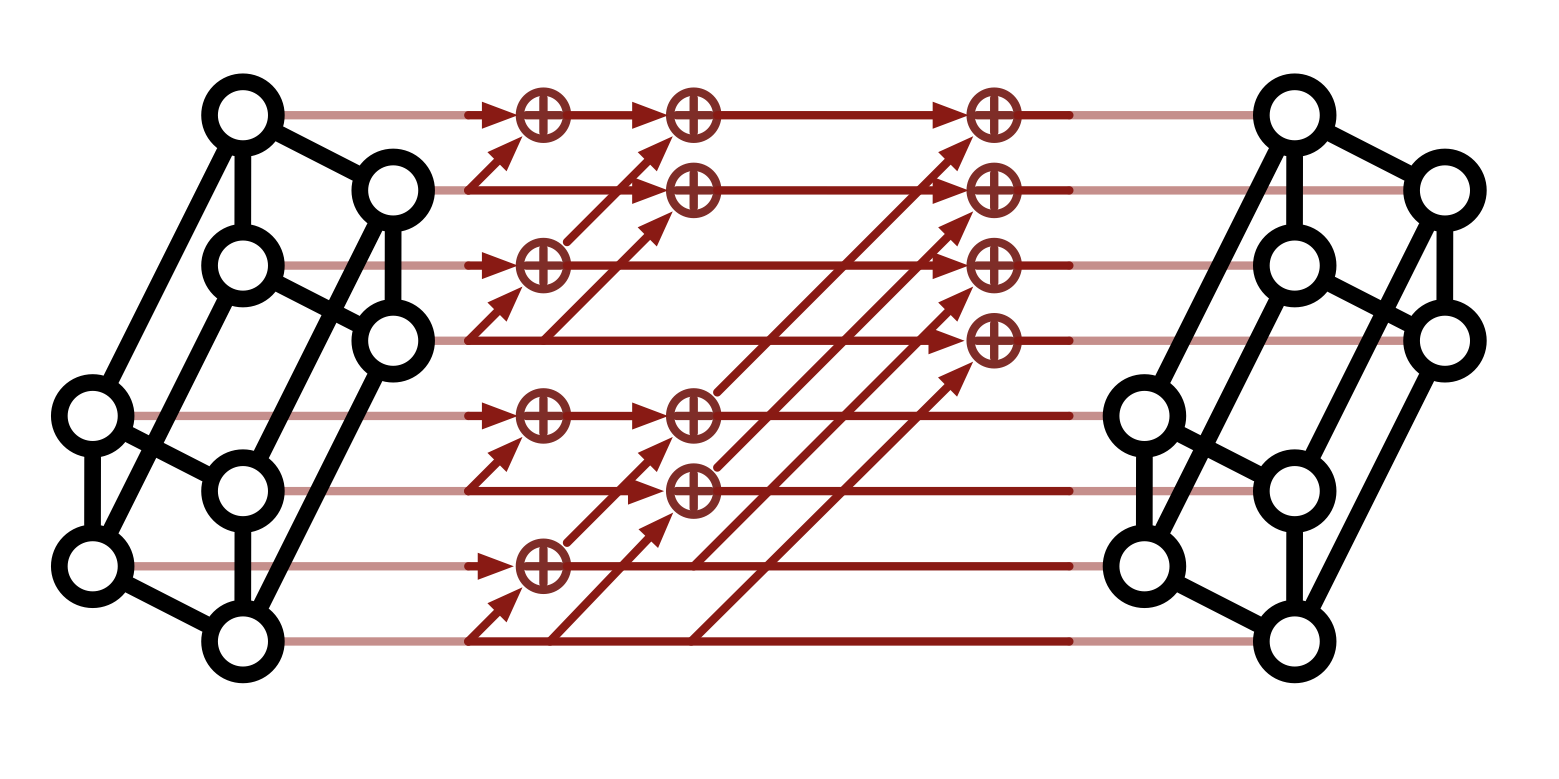
Illustration of Yates’s algorithm from my talk. I finally found a way to simultaneously depict the lattice structure and the symmetries of the circuit.

I spent a few nights in lovely Paris last week, attending the Journées Nationales d’Informatique Mathématique at Paris Diderot university.

Many computer science fields in France are organised in national, cross-institutional groupes de recherches, not completely unlike the ACM SIGs in the US. The TCS group (“Mathematical Informatics”) encompasses some 400-500 people, as far as I understand.

As in most of Europe, theoretical computer science in France includes many more fields more than US-style theory of computation. Amazingly, they meet once a year for two days, and give well-attended talks to each other. The 2012 meeting had 170 registrants, an impressive number.

This struck me as particularly noteworthy after just attending SODA, where the various subfields of algorithms become increasingly fragmented and estranged, to the point of hostility and mutual incomprehensibility.

At the Paris meeting, a steering committee selects a number speakers from the various working groups in the GDR IM, who give meaty, 45-minutes talks to a general TCS audience: Computational logic, computational geometry, distributed systems, process calculi, extremal graphs, ….

In addition, the meeting includes two 1-hour invited talks recruited outside of the French GdR. Ashwin Nayak talked about communication complexity, and I used to opportunity to present an overview of zeta transform algorithms and applications, culminating in our SODA 2012 result from last week. [slides]

Thanks to everybody who attended, and to the nice organisers for putting me into a disarmingly charming hotel in the middle of the Latin quarter, where you couldn’t swing a dead Marsipulami without hitting a comic store. I had a splendid time.

More Algorithms in Svenska Dagbladet

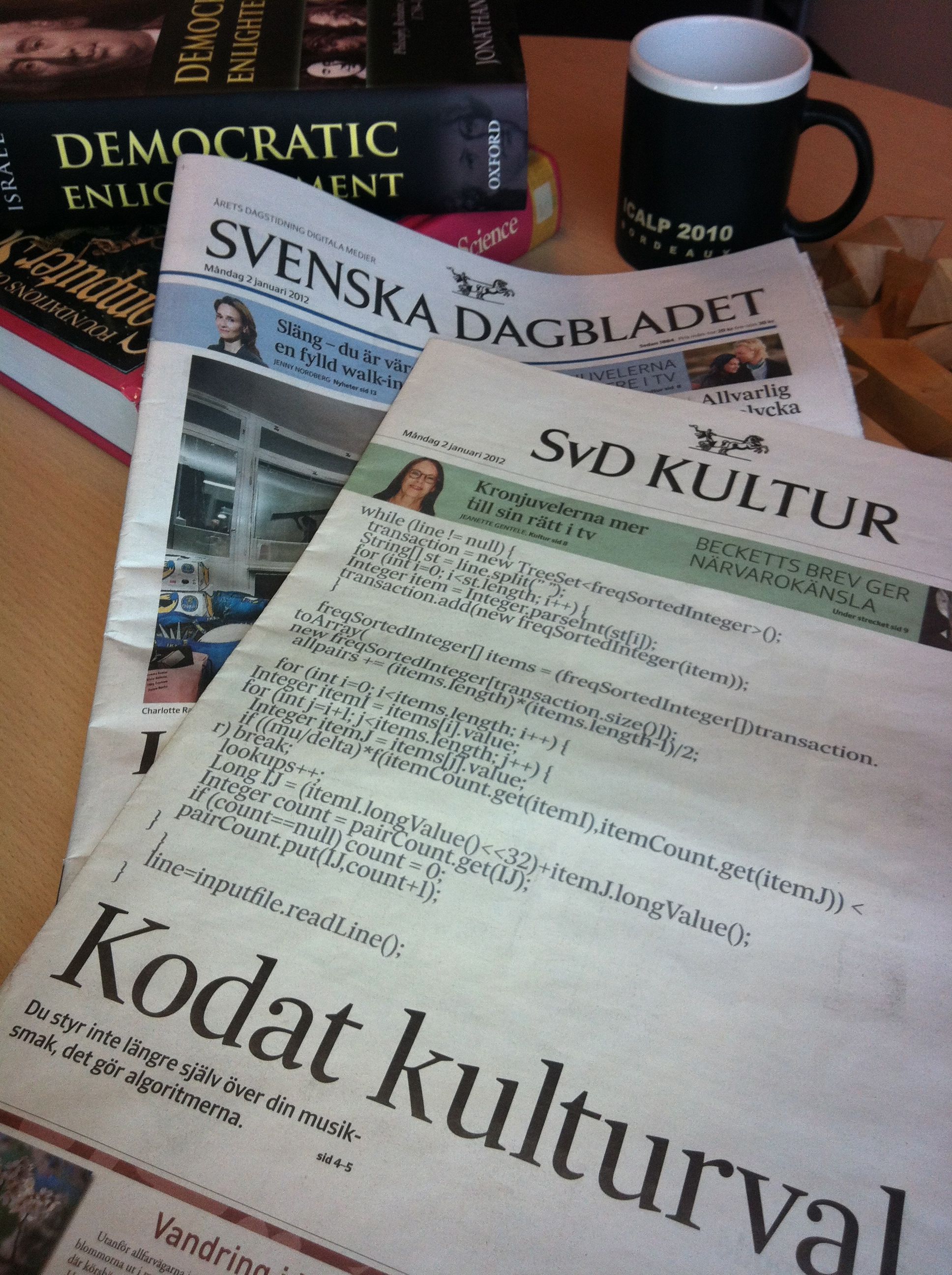
“Coded cultural choice” on the cover of SvD’s Arts section, illustrated by badly indented Java code.

My quixotic attempts to insert computer science into the memetic space of the literati continue to bear fruit. Today’s score is 3 pages in Sweden’s major newspaper Svenska Dagbladet. Of course, this only works on a day where the entire cultural elite is still hung over from actually having a life at New Years’s Eve, so there is a narrow window of opportunity where no other culture is being produced.

The article is about the effect of algorithms on the consumption of culture. One of the arguments that I’ve been trying to make for a while is that (a) the human condition is increasingly determined by access to information (b) the main force affecting information is algorithms. Thus algorithms are a worth understanding for other reasons than (a) intellectual curiosity or (b) technological progress.

The web version of the article is online at svd.se.

Such an article are the result of an interview that takes over an hour, and where I say a lot of things about a lot of things, and some subsequent emails. What ends up in the final article is a bit of hit and miss. This time, I’m pretty happy with the outcome.

Some highlights and comments:

  • My physics envy is in full display: “We teach 1960’s science like physics and chemistry in school, but you don’t learn more about algorithms now than 20 years ago.” This statement is of course not universally true; many countries do have programming and other computer science as part of the high school curriculum. But even with that proviso I think it’s safe to say that “what science should be thought in school” has changed relatively little since Sputnik. But the point of the article is of course something else: algorithms have an effect on culture (and democracy and whatnot), so the bold claim is that algorithmic thinking should be part of the Social Science curriculum. (It goes without saying that recursion ought to stand proudly next to Pascal’s law in the Science and Maths curriculum as well.)
  • The article contains a nice-looking attempt at actually Explaining What’s Going On. You can see some pseudocode in the web version, where nice-looking brand icons serve as objects that are polled for various signals about previous user behaviour. There is even a collaborative filtering aspect (since the hypothetical Facebook object is queried about what your friends like). Given the constraints under which such a page is produced, I think this came out well. The real point is of course that this code is not written by a human, but by another algorithm, so “the algorithm” performs at a meta-level. I did not find a good way to communicate that, so I didn’t try.
  • The code on the section’s front page is from the very nice data mining research done at ITU: Andrea Campagna and Rasmus Pagh, Finding Associations and Computing Similarity via Biased Pair Sampling, The Ninth IEEE International Conference on Data Mining, Miami, Florida, USA, 6-9 December 2009 pp 61-70. Proper indentation or choice of a non-proportional font is not something the newspaper graphics guy cares about. (Hell, my own students don’t.) I proudly showed this to ITU’s vice chancellor Mads Tofte, but he “would have been more impressed if it had been in ML.”
  • Lest somebody misattributes pithy quotations to quotable me, the phrase “program or be programmed” is from Douglas Rushkoff.

π out of 4 EATCS Members Don’t Care About Publication Models

Bummer.

The European Association for Theoretical Computer Science has around 1000 members, including many European TCS researchers and everybody who attended conferences like ICALP and ESA in a particular year. Traditionally, EATCS has had a close relationship to scientific publisher Springer, who publishes the proceedings of EATCS’s “flagship conference” ICALP.

A recurring theme at the EATCS general assembly meetings for the past many years has been the publication model for ICALP. Should “we” continue with Springer, or move to an open-access publisher like LIPIcs? After considerable deliberation, a ballot among EATCS members was held in late 2011.

For more background:

  1. EATCS general assembly at ICALP 2010 on my blog.
  2. EATCS general assembly at ICALP 2011 on my blog.
  3. EATCS ballot on Luca Aceto’s blog.

I have been absolutely thrilled that the EATCS council decided to send this question to its members. Well done. I want to see more of this.

Unfortunately, the outcome is not what I would have hoped. The EATCS council required a quorum of 25% of EATCS members for the ballot to be valid. I think this is a reasonable requirement – the ICALP publishing model is an important decision that should be safely moored.

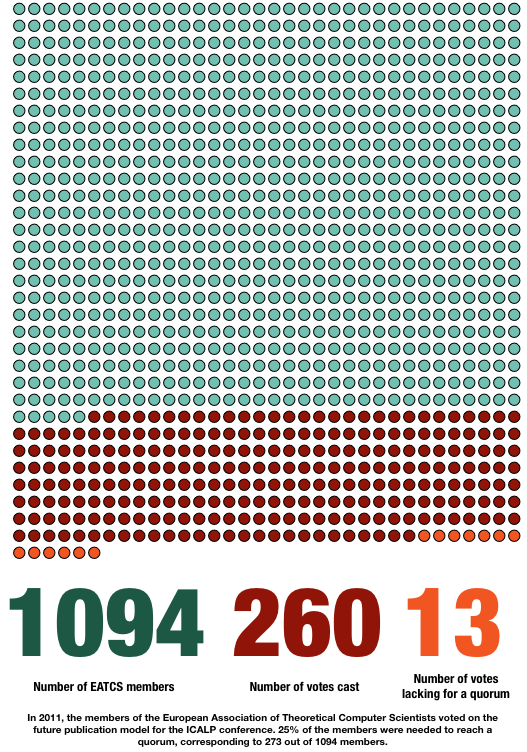
Alas, the quorum was not reached. On 9 November 2011, EATCS president Burkhard Monien informed the EATCS that out of the 1094 members, only 260 had voted. And that’s just slightly less than 1 out of 4. It’s 23.8%.

Informative graphic explaining the magnitude of the value 13 in relation to the value 1094


I am, of course, somewhat miffed that 834 EATCS members don’t seem to think that the way their research is published is sufficiently important to execute three or four mouse clicks to make their voice heard one way or the other. After all, it’s only about publication counts, accessibility, dissemination, ethics, prestige, jobs, cvs, and most everything else by which we are evaluated.

Monien adds,

However, I also want to let you know that the majority of the 260 votes were in favor of LIPIcs. EATCS will observe the further development carefully.

So at least we know the opinion of those EATCS member who care. Next time we just need to remember to inform intelligent adults of the importance to actually vote.

Sorting Networks Activity

Sorting Network in action

A 9-input sorting network in action

Computer Science Unplugged is a wonderful initiative that collects activities that communicate some basic ideas of computer science – without using computers.

IT University of Copenhagen opened its doors to the public last Friday in connection with the city-wide “Culture Night”, so I used the opportunity to implement the Sorting Networks activity.

ITU has a big stair case in its atrium, which had the proper size for a 9-input sorting network. I measured everything up, found a good-looking network in Knuth’s The Art of Computer Programming, and sketched the layout for the friendly folks at Facilities Management.

The network was “drawn” on the stairs using adhesive tape, which took a few hours on the day before the event. It looked absolutely splendid. The activity was manned with enthusiastic undergraduate students for several hours, who herded eager and intrigued guests of all ages through the maze of comparators. A smashing success.

Also, a student volunteered to translate the Wikipedia page on sorting networks into Danish, so the outreach activity had a permanent, digital result as well: Sorteringsnetværk.

Originally, I had also promised myself to produce a large poster or two next to the activity, which should explain what’s actually going on, why sorting is important, and (in particular) show a few more concrete networks of various sizes. This would have given the whole activity a bit more scientific muscle. Alas, I failed to get this done in time. Better next time.

I also failed to show up in time for the kick-off, instructing the student volunteers in how the whole thing was supposed to work. Apparently, they spent a good number of attempts running the network in the reverse direction (from the top of the stairs and down, which arguably is the obvious direction), and tried to find the bug! So now they know that sorting networks don’t necessarily work in both directions. (But insertion sort does!) This may be a fresh research question: find an optimal bidirectional sorting network for 9 inputs.

All in all, a splendid event. Thanks to everybody who helped, or just wanted to get themselves sorted out.

Exponential Time Algorithms at SODA 2012

Accepted papers for the algorithms conference SODA 2012 are announced. Best conference ever! (Compare my SODA post from last year.)

Based on my quick perusal of list of accepted papers [PDF], here’s a list of papers related to exponential time computation, together with references to online version — I’m probably missing some. Updates are welcome.

  • Counting Perfect Matchings as Fast as Ryser [arxiv.org 1107.4466], by Andreas Björklund
  • Fixed-Parameter Tractability of Directed Multiway Cut Parameterized by the Size of the Cutset, by Rajesh Chitnis, Mohammadtaghi Hajiaghayi and Dániel Marx
  • Co-nondeterminism in compositions: A kernelization lower bound for a Ramsey-type problem [arxiv 1107.3704], by Stefan Kratsch
  • Weak Compositions and Their Applications to Polynomial Lower-Bounds for Kernelization [ECCC 2011-072], by Danny Hermelin and Xi Wu
  • Subexponential Parameterized Algorithm for Minimum Fill-in [arxiv 1104.2230] by Fedor V. Fomin and Yngve Villanger
  • A Satisfiability Algorithm for AC0 [arxiv 1107.3127], by Russel Impagliazzo, William Matthews and Ramamohan Paturi
  • Compression via Matroids: A Randomized Polynomial Kernel for Odd Cycle Transversal [arxiv 1107.3068] by Stefan Kratsch and Magnus Wahlström
  • Fast zeta transforms for point lattices, by Andreas Björklund, Thore Husfeldt, Petteri Kaski, Mikko Koivisto, Jesper Nederlof and Pekka Parviainen
  • Shortest Cycle Through Specified Elements [PDF], by Andreas Björklund, Thore Husfeldt and Nina Taslaman
  • Kernelization of Packing Problems, by Holger Dell and Dániel Marx
  • Linear Kernels for (Connected) Dominating Set on H-minor-free graphs [PDF], by Fedor V. Fomin, Daniel Lokshtanov, Saket Saurabh and Dimitrios Thilikos
  • Bidimensionality and Geometric Graphs [arxiv 1107.2221], by Fedor V. Fomin, Daniel Lokshtanov and Saket Saurabh

An amazing number of kernelisation (and, I presume non-kernelisation) papers. And lots and lots of exciting papers in many other fields as well.

Quotable Me

Computer Sweden, 19 Aug 2011, page 2.

A Swedish colleague made me aware that I am featured in some kind of quote of the week in Swedish IT newspaper Computer Sweden.

On du utnyttjar en tjänst som du inte behöver betala för är det inte du som är kunden, då är det du som är varan.

Now, in the words of Alexander Smith, to be occasionally quoted is the only fame I care for, so I’m really happy. This is a step in the right direction towards a meaty, forthcoming collection of Thore’s Best Aphorisms or The Quotable Husfeldt or something like that.

(In fact, the quote doesn’t sound like very good Swedish to me. Seeing something you said quoted is strange already. Seeing something you said in your fourth language is even stranger.)

The quote must come from a recent interview with Svenska Dagbladet inspired by the filter bubble, and is aimed at Google’s business model. It goes without saying that there are plenty of free IT products, in particular from the open source community, that don’t view me as a product. Syntactic awkwardness and quibbles of generality aside, I think it’s a good quote.

In the words of Monty Python’s Oscar Wilde sketch, I wish I had said it.

Here’s the source:

If you’re not paying for something, you’re not the customer; you’re the product being sold.

The quote opens chapter 1 of Eli Pariser’s book The Filter Bubble and is attributed to Andrew Lewis, under the handle blue_beetle. Much pithier. In fact, the quoted website metafilter.com gives the quote as “[…] paying for it […]”.

(Of course, Wilde probably already said it a century ago, and even better.)

ICALP 2011

I am back from sunny Zürich and ICALP 2011.

Attendee at ICALP 2011 business meeting. The image shows the free ice cream and name tag.

This was a very well-organised event hosted at ETH. Michael Hoffmann had everything under complete control and remained confident, alert, calm and accessible. I’ve tried go take a glimpse behind the curtains, such as looking at the two-page to-do list for technical staff in the lecture halls, and the level of detail and relevance is just off the scale. I hope Michael can summarise his preparation and tips for everybody’s benefit.

Future Publication of the ICALP Proceedings

The EATCS general assembly is by tradition a long and dry event without free beer. To break new ground, the organisers handed out free ice cream. ’tis not beer, but a welcome step in the right direction. I hope the organisers of next year’s ICALP, Warwick, take note.

Burkhard Monien’s EATCS Annual report 2010-2011 [PDF] is available on-line, so there’s no need to summarise it here.

The exciting question is the publication model for ICALP: will the EATCS flagship conference stay with Springer’s LCNS series (or some transformation of it) or not? I blogged about this last year, from the 2010 assembly:

Monien explained the EATCS council wants to get this right, ICALP is a big steamer, should not go in zig-zag course, and stick to its decisions. He was unsure if the next poll will be implemented in the Fall, but promised “beginning of next year, at the latest.” I’m not holding my breath.

Well, the Fall of 2010 has come and gone. The EATCS council had another meeting during ICALP 2011, and Monien summarised the decision. Here’s what I was able to jot down quickly from his presentation:

  • The decision is between Springer and the LIPIcs series and will be decided by the members of EATCS by a ballot “at the end of the summer.”
  • The EATCS Council recommends to go with Springer.
  • The poll will include the following documents: The proposals from both Springer and LIPIcs. The recommendation of the EATCS council. A dissenting opinion from a minority in the Council. A list of pros and cons.
  • The final decision is made by simple majority among EATCS members. A quorum of 25% is necessary.

For a quick calculation, the report currently lists 787 EATCS members. So some 200 members would need to respond. Get out the vote!

As a sign that times are changing, the ICALP proceedings were online and digitally available to all conference attendees at the time of the conference. Splendid.

Name Tags

I obsess about name tags.

ICALP 2011 chose the neck band solution, which I derided in a brilliant piece of investigative journalism Post ALGO 2009.

In the comments of that post, G. Philip suggested to print names on both sides of the tag, so as to increase the probability of legibility close to 1. Remarkably, this was exactly what the organisers had done!

(Again, enterprising conference attendees managed to defeat the good intentions. The lunch tickets happened to fit exactly in the name tag pocket, so that with probability close to 1/2, the tag showed the name badge, and with probability close to 1/2, it showed lunch tickets. Incidentally, lunch tickets also had your name on them, but only printed on one side. Thus, in total, attendees were identifiable with probability around 3/4.)

But the big problem with neck bands is that the name badge ends up below table height during lunch and also otherwise is awkward to inspect.

The layout of the ICALP 2011 badge is fair. A good part of the real estate is actually taken up by the attendee’s name. Also, accents were correct as far as I could tell.

In fact, the organisers chose to display first names in larger size, giving the event a friendly touch. I like this. However, during a thoughtful lunch conversation, somebody (I don’t know who because his name tag was dangling below the table) mentioned that the last name is more useful for striking up conversations. Especially newcomers would prefer to know that they’re talking to Turing instead of Alan.

I’m undecided about the name size issue. Maybe another EATCS poll can decide it.